Trigonometric functions and the unit circle
The unit circle
The unit circle is a circle with radius 1 centered at the origin (0,0) in the coordinate plane. It's fundamental to understanding trigonometric functions s i n ( x ) sin(x) s in ( x ) c o s ( x ) cos(x) cos ( x )
Interactive Unit Circle Visualization
ASTC rule
The ASTC rule is an acronym for remembering the positive signs of the trigonometric functions in each quadrant of the unit circle.
A: All
S: Sine
T: Tangent
C: Cosine
Sine and cosine
Trigonometry cheat sheet: link
The sine and cosine functions are defined as the y and x coordinates of a point on the unit circle, respectively.
We also define the tangent function as the ratio of sine and cosine:
tan ( x ) = sin ( x ) cos ( x ) \tan(x) = \frac{\sin(x)}{\cos(x)}
tan ( x ) = cos ( x ) sin ( x )
Properties of sine and cosine
Domain : all real numbers.Range : [ − 1 , 1 ] [-1, 1] [ − 1 , 1 ]
They are periodic with period 2 π 2\pi 2 π s i n ( x + 2 π ) = s i n ( x ) sin(x + 2\pi) = sin(x) s in ( x + 2 π ) = s in ( x ) c o s ( x + 2 π ) = c o s ( x ) cos(x + 2\pi) = cos(x) cos ( x + 2 π ) = cos ( x )
They are bounded between -1 and 1.
They are continuous.
sin ( x ) = cos ( π 2 − x ) \sin(x) = \cos(\frac{\pi}{2} - x) sin ( x ) = cos ( 2 π − x ) cos ( x ) = sin ( π 2 − x ) \cos(x) = \sin(\frac{\pi}{2} - x) cos ( x ) = sin ( 2 π − x )
Graphs
The graphs of the sine and cosine functions are shown below.
Pythagorean identity
sin 2 ( x ) + cos 2 ( x ) = 1 \sin^2(x) + \cos^2(x) = 1
sin 2 ( x ) + cos 2 ( x ) = 1
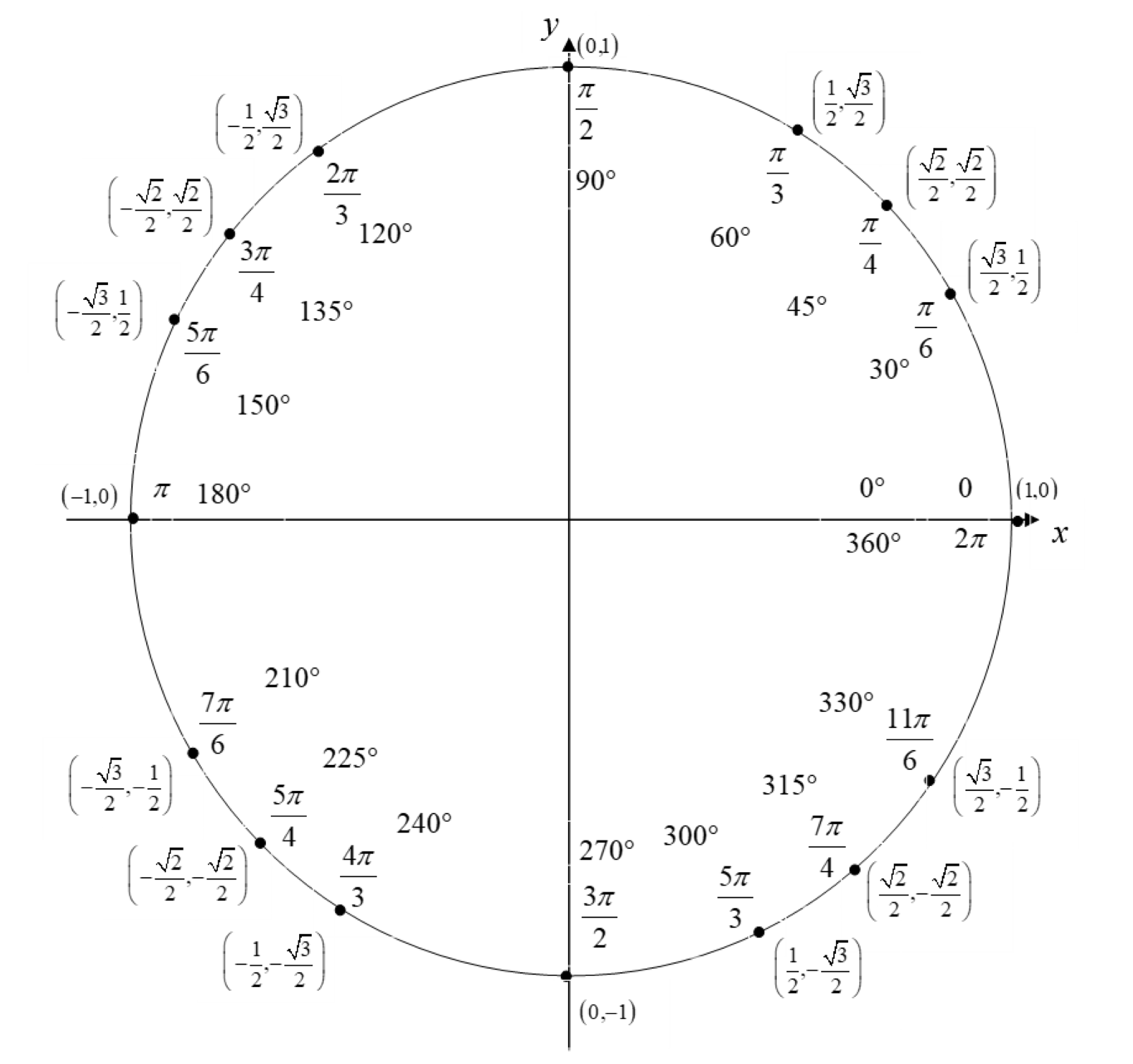
Common values
(image source: link )
Exercises
1. Basic trigonometric function values
Round your answers to 2 decimal places.
a) What is sin ( π 6 ) \sin(\frac{\pi}{6}) sin ( 6 π )
b) What is cos ( π 4 ) \cos(\frac{\pi}{4}) cos ( 4 π )
c) What is tan ( π 3 ) \tan(\frac{\pi}{3}) tan ( 3 π )
d) What is sin ( π 2 ) \sin(\frac{\pi}{2}) sin ( 2 π )
e) What is cos ( π ) \cos(\pi) cos ( π )
f) What is sin ( 3 π 2 ) \sin(\frac{3\pi}{2}) sin ( 2 3 π )
2. ASTC rule and quadrant identification
For each angle, identify which quadrant it's in and whether the given trigonometric function is positive or negative.
a) sin ( 2 π 3 ) \sin(\frac{2\pi}{3}) sin ( 3 2 π )
b) cos ( 5 π 4 ) \cos(\frac{5\pi}{4}) cos ( 4 5 π )
c) tan ( 7 π 6 ) \tan(\frac{7\pi}{6}) tan ( 6 7 π )
d) sin ( 11 π 6 ) \sin(\frac{11\pi}{6}) sin ( 6 11 π )
3. Graphical analysis
Using the interactive unit circle above or graphing software:
a) For what values of x x x [ 0 , 2 π ] [0, 2\pi] [ 0 , 2 π ] sin ( x ) = cos ( x ) \sin(x) = \cos(x) sin ( x ) = cos ( x )
b) For what values of x x x [ 0 , 2 π ] [0, 2\pi] [ 0 , 2 π ] sin ( x ) = − 1 2 \sin(x) = -\frac{1}{2} sin ( x ) = − 2 1
c) For what values of x x x [ 0 , 2 π ] [0, 2\pi] [ 0 , 2 π ] cos ( x ) = 3 2 \cos(x) = \frac{\sqrt{3}}{2} cos ( x ) = 2 3
d) What is the maximum value of sin ( x ) + cos ( x ) \sin(x) + \cos(x) sin ( x ) + cos ( x ) x x x [ 0 , 2 π ] [0, 2\pi] [ 0 , 2 π ]
4. Pythagorean identity practice
Use the Pythagorean identity sin 2 ( x ) + cos 2 ( x ) = 1 \sin^2(x) + \cos^2(x) = 1 sin 2 ( x ) + cos 2 ( x ) = 1
(Round your answers to 2 decimal places.)
a) If sin ( x ) = 3 5 \sin(x) = \frac{3}{5} sin ( x ) = 5 3 x x x cos ( x ) \cos(x) cos ( x )
b) If cos ( x ) = − 4 5 \cos(x) = -\frac{4}{5} cos ( x ) = − 5 4 x x x sin ( x ) \sin(x) sin ( x )
c) If sin ( x ) = − 12 13 \sin(x) = -\frac{12}{13} sin ( x ) = − 13 12 x x x cos ( x ) \cos(x) cos ( x )
5. Periodicity and symmetry
Round your answers to 2 decimal places.
a) What is sin ( 13 π 6 ) \sin(\frac{13\pi}{6}) sin ( 6 13 π )
b) What is cos ( − π 3 ) \cos(-\frac{\pi}{3}) cos ( − 3 π )
c) What is sin ( 7 π 4 ) \sin(\frac{7\pi}{4}) sin ( 4 7 π )
6. Challenge exercises
lim x → 0 sin ( x ) x \lim_{x \to 0} \frac{\sin(x)}{x}
x → 0 lim x sin ( x )
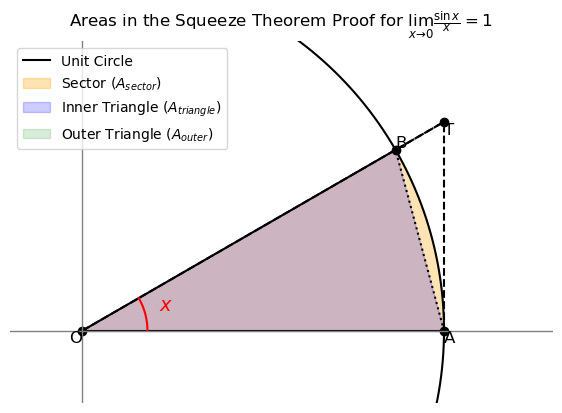
Solution using squeeze theorem:
Triangle area: A t r i a n g l e = 1 2 sin ( x ) cos ( x ) A_{triangle} = \frac{1}{2} \sin(x) \cos(x) A t r ian g l e = 2 1 sin ( x ) cos ( x )
Sector area: A s e c t o r = x 2 A_{sector} = \frac{x}{2} A sec t or = 2 x x 2 π π r 2 = x 2 \frac{x}{2\pi} \pi r^2 = \frac{x}{2} 2 π x π r 2 = 2 x r = 1 r=1 r = 1
Outer triangle area: A o u t e r = 1 2 tan ( x ) = 1 2 sin ( x ) cos ( x ) A_{outer} = \frac{1}{2} \tan(x) = \frac{1}{2} \frac{\sin(x)}{\cos(x)} A o u t er = 2 1 tan ( x ) = 2 1 c o s ( x ) s i n ( x )
We have A t r i a n g l e ≤ A s e c t o r ≤ A o u t e r A_{triangle} \leq A_{sector} \leq A_{outer} A t r ian g l e ≤ A sec t or ≤ A o u t er sin ( x ) cos ( x ) 2 ≤ x 2 ≤ sin ( x ) 2 cos ( x ) \frac{\sin(x)\cos(x)}{2} \leq \frac{x}{2} \leq \frac{\sin(x)}{2\cos(x)} 2 s i n ( x ) c o s ( x ) ≤ 2 x ≤ 2 c o s ( x ) s i n ( x ) cos ( x ) ≤ x sin ( x ) ≤ 1 cos ( x ) \cos(x) \leq \frac{x}{\sin(x)} \leq \frac{1}{\cos(x)} cos ( x ) ≤ s i n ( x ) x ≤ c o s ( x ) 1 1 cos ( x ) ≤ sin ( x ) x ≤ cos ( x ) \frac{1}{\cos(x)} \leq \frac{\sin(x)}{x} \leq \cos(x) c o s ( x ) 1 ≤ x s i n ( x ) ≤ cos ( x )
lim x → 0 1 cos ( x ) = 1 = lim x → 0 cos ( x ) \lim_{x \to 0} \frac{1}{\cos(x)} = 1 = \lim_{x \to 0} \cos(x)
x → 0 lim cos ( x ) 1 = 1 = x → 0 lim cos ( x )
By squeeze theorem, we have lim x → 0 sin ( x ) x = 1 \lim_{x \to 0} \frac{\sin(x)}{x} = 1 lim x → 0 x s i n ( x ) = 1
lim x → 0 x sin ( 1 x ) \lim_{x \to 0} x \sin(\frac{1}{x})
x → 0 lim x sin ( x 1 )
lim x → 0 tan ( x ) x \lim_{x \to 0} \frac{\tan(x)}{x}
x → 0 lim x tan ( x )
lim x → 0 sin ( 5 x ) x \lim_{x \to 0} \frac{\sin(5x)}{x}
x → 0 lim x sin ( 5 x )