lecture 7: Exponential and Logarithmic Functions — Graphs, Domain and Range, Discontinuities, and Infinity Behavior
Exponential Functions
1. What Is an Exponential Function?
An exponential function has the form:
f(x)=ax
Where:
- a>0 and a=1
- x is any real number
Example: f(x)=2x, f(x)=10x, f(x)=ex
2. Real-World Examples
- Bacteria growth: population doubles every hour
- Finance: compound interest over time
- Physics: radioactive decay
These all grow (or decay) exponentially — very fast!
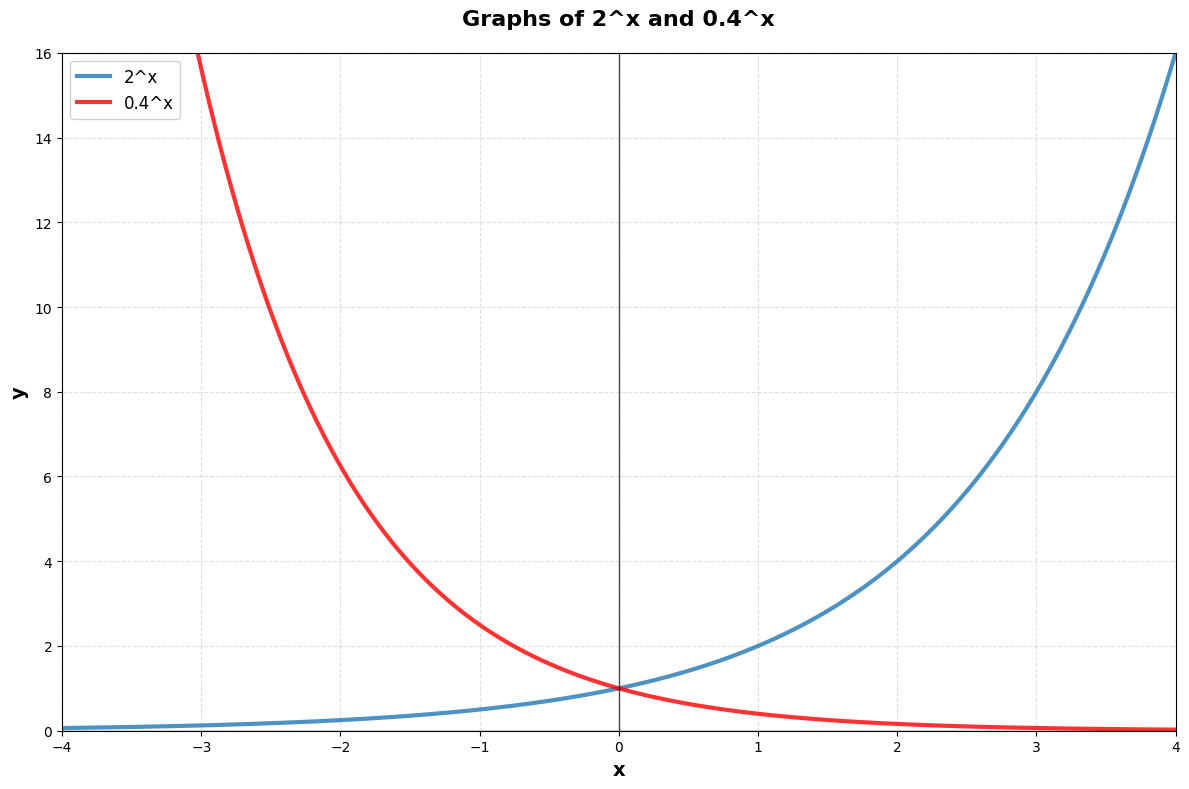
3. Graph and Behavior
| Function |
Graph Shape |
Domain |
Range |
Discontinuities |
| f(x)=ax (for a>1) |
Grows rapidly |
R |
(0,∞) |
None |
| f(x)=ax (for 0<a<1) |
Decreases rapidly |
R |
(0,∞) |
None |
Horizontal asymptote at y=0
Graph of 2x and 0.4x
Logarithmic Functions
1. What Is a Logarithm?
A logarithm is the inverse of an exponential function.
logb(x)=y⟺by=x
- b>0, b=1
- Most common: log10(x), log2(x), and ln(x) (natural log, base e)
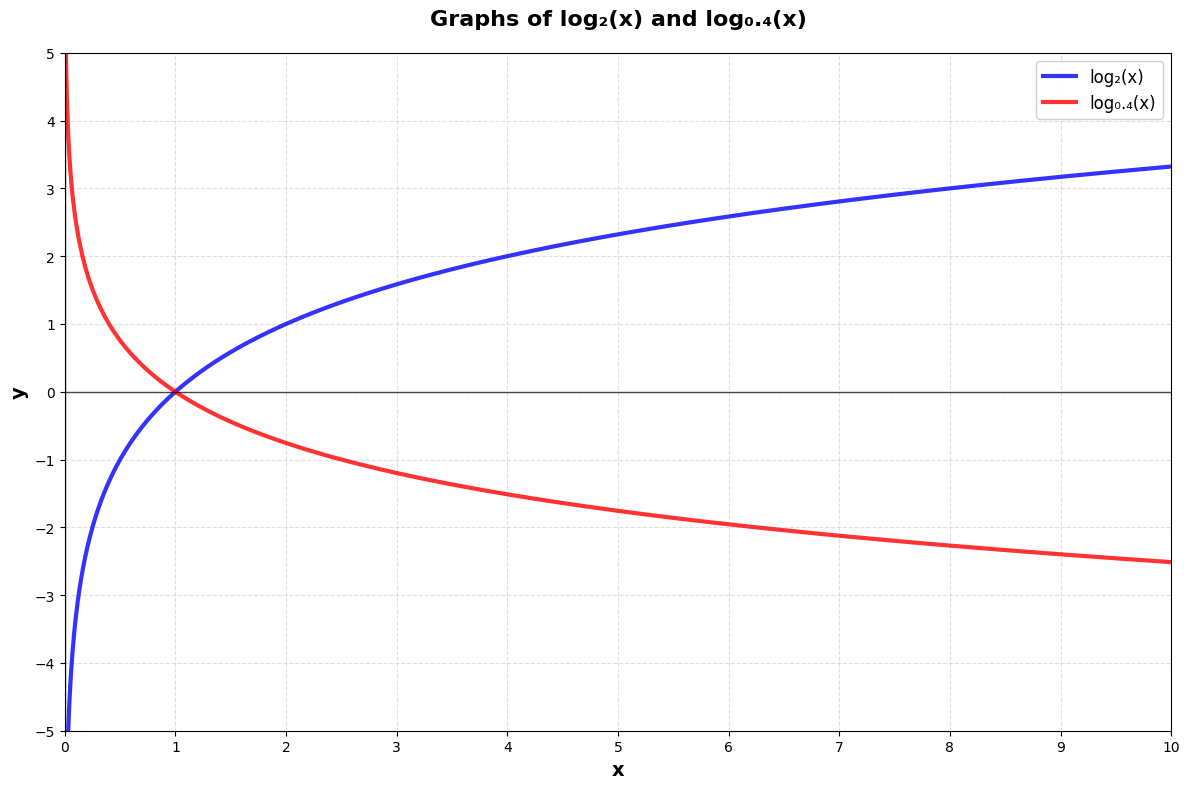
2. Graph and Behavior
| Function |
Graph Shape |
Domain |
Range |
Discontinuities |
| f(x)=logb(x) for b>1 |
Increases slowly |
(0,∞) |
R |
Vertical asymptote at x=0 |
| f(x)=logb(x) for 0<b<1 |
Decreases slowly |
(0,∞) |
R |
Vertical asymptote at x=0 |
No output for x≤0
Graph of log2(x) and log0.4(x)
Domain and Range Summary
| Function |
Domain |
Range |
| f(x)=ax |
R |
(0,∞) |
| f(x)=logb(x) |
(0,∞) |
R |
Infinity Behavior
Exponential Growth
- If a>1:
f(x)=ax→∞ as x→∞,
f(x)→0 as x→−∞
Exponential Decay
- If 0<a<1:
f(x)→0 as x→∞,
f(x)→∞ as x→−∞
Logarithmic Behavior
f(x)=logb(x)
-
If b>1:
f(x)→∞ as x→∞
f(x)→−∞ as x→0+
-
If 0<b<1:
f(x)→−∞ as x→∞
f(x)→∞ as x→0+
Discontinuities and Asymptotes
1. Exponential Functions
- No discontinuities
- Horizontal asymptote: y=0
- Smooth and continuous everywhere
2. Logarithmic Functions
- Essential discontinuity (vertical asymptote) at x=0
- Not defined for x≤0
- No removable discontinuities
Logarithmic Properties
All rules and properties are valid for any base b>0 and b=1, and can be proven using the definition of logarithms (by=x⟺logb(x)=y).
- logb(1)=0
- logb(b)=1
- logb(bx)=x
- blogb(x)=x
Rules of logarithms:
- logb(xy)=logb(x)+logb(y)
- logb(x/y)=logb(x)−logb(y)
- logb(xk)=klogb(x)
Change of base formula:
- logb(x)=logk(b)logk(x)
Regular Exercises
1. Calculate the following
a) What is log2(8)?
Think: 2 raised to what power equals 8?
b) What is log3(91)?
Think: 3 raised to what power equals 1/9?
c) What is 2log2(5)?
This is testing the inverse relationship between exponentials and logarithms
d) What is 4log2(3)?
Think: 2 raised to what power equals 3?
2. Domain and Range Practice
Determine the domain and range of each:
- a) f(x)=3x2−4
- b) f(x)=log10(x2−1)
- c) f(x)=log10(2−x)
Solution
a) (f(x)=3x2−4)
- Exponential functions are always defined for all real numbers.
- So, domain: (R)
- The base 3 raised to any power is always positive, so the output is always greater than 0.
- Range: ((0,∞))
b) (f(x)=log10(x2−1))
- Logarithms are only defined for positive inputs.
- So:
x2−1>0⇒x2>1⇒x<−1 or x>1
- Domain: (−∞,−1)∪(1,∞)
- Since (x2−1) can get very large or very small positive values, the output (log) can be any real number.
- Range: (R)
c) f(x)=log10(2−x)
- Require: 2−x>0⇒x<2
- Domain: ((−∞,2))
- As x→−∞, 2−x→∞, so log10(2−x)→∞
- As x→2−, 2−x→0+, so log10(2−x)→−∞
- Range: R
3. Prove Logarithmic Properties
Use the definition logb(x)=y⟺by=x to prove the following properties:
- a) logb(xy)=logb(x)+logb(y)
- b) logb(x/y)=logb(x)−logb(y)
- c) logb(xk)=klogb(x)
Solution
a) Prove: logb(xy)=logb(x)+logb(y)
Let:
logb(x)=m⇒bm=xandlogb(y)=n⇒bn=y
Multiply:
xy=bm⋅bn=bm+n⇒logb(xy)=m+n=logb(x)+logb(y)
b) Prove: logb(x/y)=logb(x)−logb(y)
Let logb(x)=m and logb(y)=n
⇒x=bm,y=bn⇒yx=bnbm=bm−n⇒logb(x/y)=m−n=logb(x)−logb(y)
c) Prove: logb(xk)=klogb(x)
Let logb(x)=m⇒x=bm
xk=(bm)k=bkm⇒logb(xk)=km=klogb(x)
4. Bacteria Growth
A scientist is growing a bacteria culture in a lab. At the start, there are 100 bacteria. The population doubles every 3 hours.
Questions:
-
a) Write an exponential function P(t) that models the population after t hours.
-
b) How many bacteria will there be after 12 hours?
-
c) After how many hours will the population reach at least 6,400 bacteria?
Solution
a) The bacteria doubles every 3 hours starting from 100.
General exponential form:
P(t)=P0⋅2t/3
So:
P(t)=100⋅2t/3
b) After 12 hours:
P(12)=100⋅212/3=100⋅24=100⋅16=1600
So, 1600 bacteria after 12 hours.
c) Want:
100⋅2t/3≥6400⇒2t/3≥64⇒2t/3=26⇒3t=6⇒t=18
So, the population reaches at least 6400 after 18 hours.
5. Solve the exponential equation
Solve for x:
52x=5x+1−6
Solution
Solve:
52x=5x+1−6
Let’s set y=5x.
Then:
52x=(5x)2=y2,5x+1=5⋅5x=5y
Substituting:
y2=5y−6⇒y2−5y+6=0⇒(y−2)(y−3)=0⇒y=2 or y=3
Recall y=5x:
- If 5x=2⇒x=log5(2)
- If 5x=3⇒x=log5(3)
Final answers:
x=log5(2)orx=log5(3)
6. Solve the logarithmic equation
Solve for x:
4log3(x2)−log3(x)=14
Solution
Given:
4log3(x2)−log3(x)=14
Use log power rule:
log3(x2)=2log3(x)⇒4⋅2log3(x)=8log3(x)
So the equation becomes:
8log3(x)−log3(x)=14⇒7log3(x)=14⇒log3(x)=2
Now rewrite in exponential form:
x=32=9
Final answer: x=9
Extra Advanced Exercises
1. Exponential and Logarithmic Equation Combo
Solve for ( x ):
2x=5x−1
2. Domain Puzzle: Log of a Log
Find the domain of:
f(x)=log2(log3(x−1))
3. Change of base formula.
Prove the change of base formula for the log function:
logb(x)=logk(b)logk(x)